
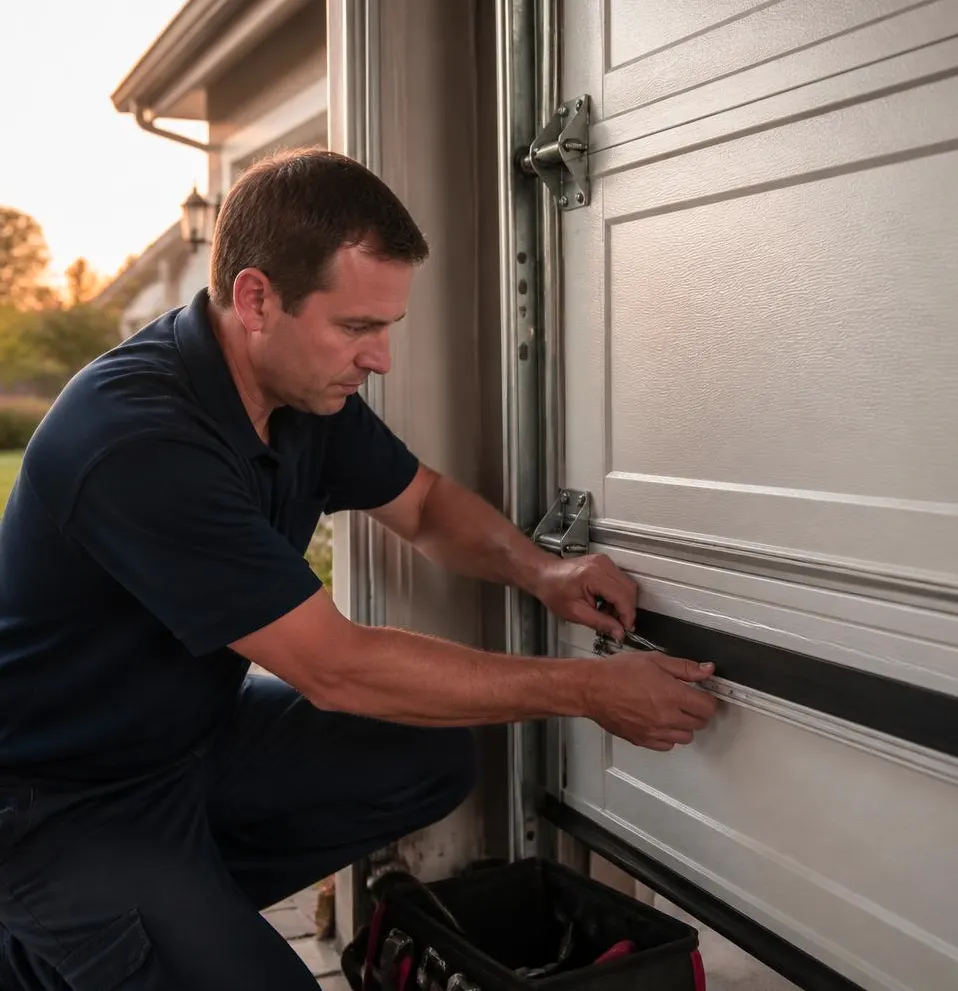
The Cost of Waiting Another Season
Here's the uncomfortable math: a garage door spring that lets go while someone's standing under it doesn't send you a warning first. Neither does an opener with no auto-reverse function when a kid's bike, a pet, or a foot ends up under a closing door. Ignoring this for another season doesn't save money — it just moves the bill from "scheduled retrofit" to "emergency repair plus possibly an ER visit." That's the argument in one sentence. Now let's get specific about what actually needs attention and what's just old paint.
What Actually Needs to Change
Not every outdated-looking door is unsafe. But a few specific things on doors from the 1990s or earlier were either never required by safety codes at the time or wear out in ways that aren't obvious from the driveway.
No Auto-Reverse Sensors
If your door doesn't have small photo-eye sensors mounted near the floor on each side of the track, it will not stop or reverse if something is in its path. This was standard-issue on new installs starting in the mid-1990s, but plenty of older systems were never retrofitted. This is the single most important upgrade on this whole list, especially in households with kids, dogs, or anyone who backs out of the garage without double-checking.
No Spring Containment Cables
Torsion springs store an enormous amount of tension. Without a containment cable running through the spring, a sudden break sends metal fragments flying instead of letting the spring drop harmlessly in place. If your springs are original to the house, assume they've outlived their realistic service life and ask about containment cables at the same time you replace them — not as a separate project later.
Old Opener, No Rolling Code
Openers from this era often use a fixed signal code, which means a cheap code-grabber can capture and replay it. Beyond the security angle, these older units also frequently lack the force-sensing adjustments that let a door stop on contact with resistance. A modern opener closes both gaps at once.
Worn Weatherstripping and Bottom Seal
This one's less about injury and more about what's quietly getting into the garage. Heavy rain and high humidity push moisture under doors with cracked or missing seals, and that moisture sits against wood shelving, stored boxes, and vehicle undercarriages longer than it should in this climate. A new bottom seal and side weatherstripping is a low-cost fix that prevents a slow rot problem.
What You Can Leave Alone
Here's the other half of the argument, because this isn't a case for replacing the whole door. If the panels are solid steel or wood without visible rust-through, warping, or delamination, there's no safety reason to replace them. A well-built door from the 90s with solid panels, intact hinges, and tracks that aren't bent can run for years once the sensors, cables, and opener are brought up to date. Replacing a structurally sound door purely because of its age is money spent on cosmetics, not safety — save that budget for insulation or a quieter opener down the line if you want, but it's a want, not a need.
Hardware that's simply old but still functioning correctly — rollers, hinges, the track itself — doesn't need wholesale replacement either. Lubricate it, check it during a seasonal tune-up, and replace individual parts only when they show actual wear: grinding noise, visible rust pitting, or a roller that's cracked rather than just dirty.
Why the Lowcountry Climate Changes the Math
Garages here deal with more than the national average. Heavy rain and high humidity accelerate rust on springs, cables, and track hardware, especially in garages near pine trees where moisture and dropped needles collect at the base of the door. Pollen season adds a gritty film to tracks and rollers that turns into grinding paste if it's not cleaned off. And while ice storms are rare, they're not impossible — a frozen bottom seal or stiff spring on a cold morning behaves differently than it does in July, so an aging system that was already borderline tends to show its weak points right when a cold snap or a tropical system rolls through. All of this means an older door in this area needs its safety hardware checked more often than the same door would in a drier, milder climate.
When to Call North Charleston Garage Door
If your door doesn't have working auto-reverse sensors, if you can see bare torsion springs with no containment cable, or if the opener is original to the house and you're not sure it has any force-sensing safety feature, that's the point to stop debating and get it looked at. North Charleston Garage Door handles spring replacement with proper containment cables installed at the same time, and garage door opener repair and installation for households ready to move up to a modern, rolling-code unit with real safety sensors. A technician can walk through your specific door, tell you honestly what's a safety issue and what's just old, and give you a plan instead of a guess.
If your door is from the 1990s or earlier and you're not sure which category it falls into, call North Charleston Garage Door for a straightforward inspection and let's settle it for good.